
Metro Record Staff
Opinion | November 4, 2026
CHARLOTTE — North Carolina voters approved a constitutional amendment requiring limits on local property-tax increases. The unofficial result: 60.4% voted yes.
But the amendment does not say what those limits are.
It sets no cap, formula, exceptions or deadline for putting a limit in place. Instead, it directs the General Assembly to write a law later. Voters approved the direction. The people who will write the substance were not on the ballot.
That is the central accountability question raised by this vote: What did voters agree to when the amendment left the essential terms unanswered?
The amendment’s ballot question said: “Constitutional amendment requiring limits on property tax increases by local governments.” The constitutional language in House Bill 1089 says the General Assembly “shall enact general laws limiting the amount by which the levy of taxes on property may increase, which may include exceptions.”
That is the complete instruction. The state has yet to specify how much a levy may increase, how the limit would be calculated, what exceptions would apply or when the law would take effect.
A 2%-above-growth model discussed by the Tax Foundation before a legislative committee was not included in the amendment or the ballot question. It is one possible blueprint, not the policy voters approved.
The amendment passed, but its practical meaning remains unwritten.
The missing terms were the substance
A constitutional amendment that leaves every operative detail to future legislation is not a fully described tax policy. Voters could not assess the size of the limit, who might be exempt or how it would interact with local budgets. Supporters could argue for property-tax restraint without committing to a specific cap. Opponents could warn about consequences without knowing what the final rules would be.
That is not a minor gap in the fine print. It is the fine print.
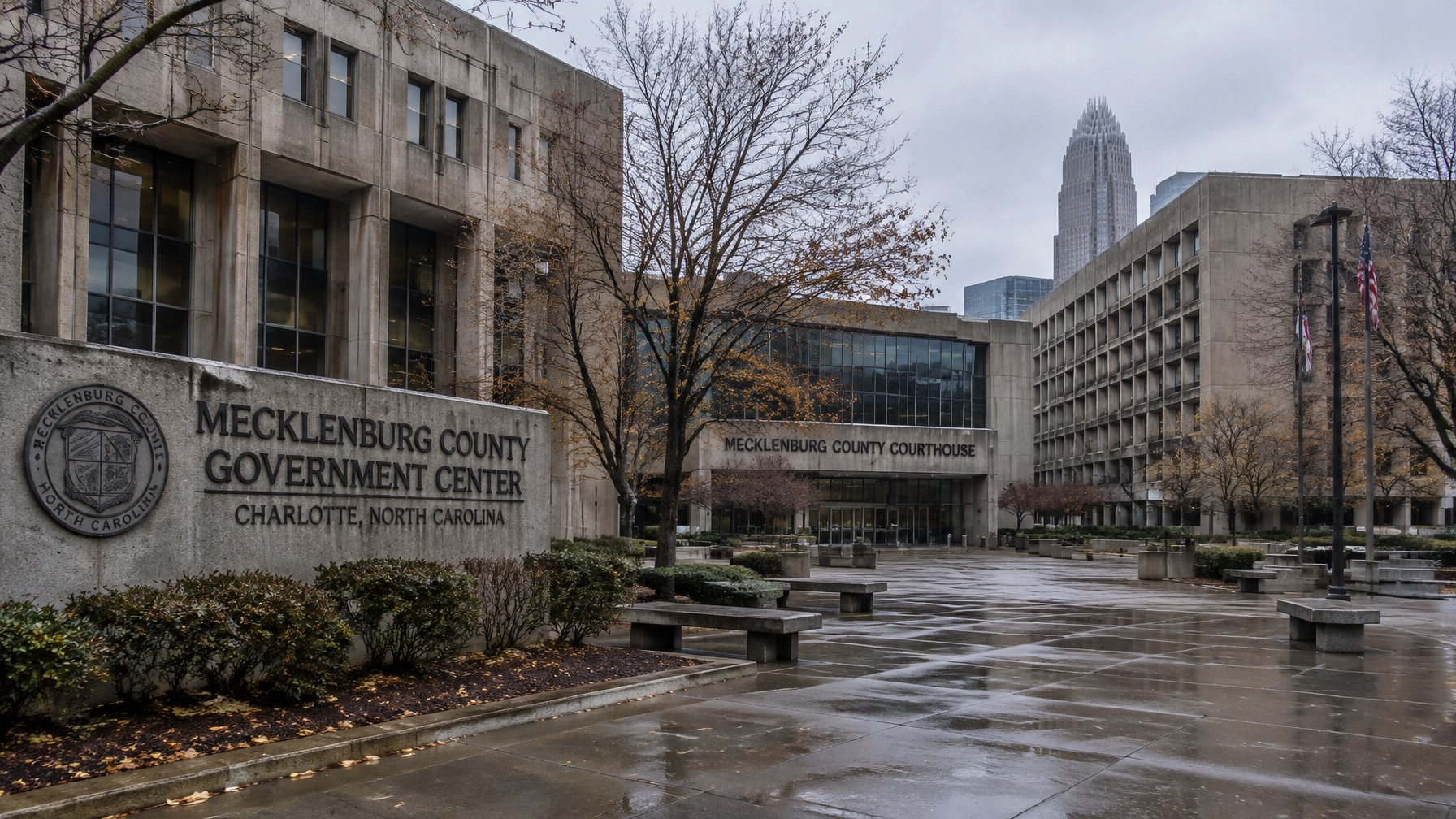
Local-government officials raised concerns before the election. Mecklenburg County’s Board of Commissioners unanimously adopted a resolution opposing the amendment in April. The county identified property tax as its largest funding source for services including education, public safety, health and human services, community development and debt service. Charlotte’s government said it could not assess the amendment’s budget impact without specific parameters, and could not tell how a future limit would interact with the county’s 2027 revaluation.
When the city expected to be governed by the amendment could not estimate its effects, voters had even less information with which to judge the policy.
The amendment was criticized as vague before the vote. Yet voters were still asked to put its instruction into the state constitution. Calling that a misleading way to present a tax change is not a claim that the words were hidden. They were on the ballot. The problem is that the words promised a limit without telling voters what kind of limit they were authorizing.

What the modeling suggests, and what it cannot prove
There is one available illustration of how a levy limit might affect local budgets. The North Carolina Housing Coalition modeled a hypothetical cap allowing property-tax revenue to grow with a jurisdiction’s growth plus 2%. The coalition used that scenario because a similar model had been presented to lawmakers. It was not the amendment’s formula; the amendment has none.
Under that hypothetical, the coalition estimated nearly $1 billion less in revenue for local governments across the state. It reported that 73% of counties and about 90% of the 75 municipalities it analyzed would have lost property-tax revenue in the revaluation years studied.
For homeowners, the modeled average savings were about $84 a year, roughly $7 a month. In the state’s Tier 1 distressed counties, the average was about $77 a year. The coalition also estimated that large corporate landowners could receive far greater savings, ranging from tens of thousands to more than a million dollars in some cases.
The analysis reported that under its model, the savings for the Apple data center in Maiden would have exceeded the combined savings for homeowners there. It also identified substantial potential savings for large utilities and apartment owners.
Those are estimates under a hypothetical scenario, not predictions of what North Carolina law will do. The coalition itself describes the analysis as retroactive and illustrative. A different cap, different exceptions or different treatment of growth could produce different results. The report cannot tell Charlotte what it will lose, or a particular homeowner what they will save.
But the model raises a question the new law must answer: If a statewide limit constrains local revenue, while offering relatively modest modeled savings to the average homeowner and larger potential savings to some major property owners, whose interests does the policy serve?
Why Mecklenburg’s calendar sharpens the question
Mecklenburg County’s revaluation is already underway. The county says its initial review covered 428,506 residential and commercial parcels, with median values up about 15% for residential properties and 30% for commercial properties. Those are preliminary assessment changes, not automatic tax-bill increases. New values are scheduled to be announced in early 2027, and local elected officials will set tax rates in the spring.

That process now coincides with the 2027 legislative session in which lawmakers must write the levy-limit law.
The legislature will be deciding the rules at the moment Mecklenburg’s new assessments make those rules consequential. Yet it is not known whether the eventual law will apply to the 2027 budget cycle, how it will treat revaluation, or what exceptions it will permit. The amendment does not answer those questions. The enabling bill has not been written.
Mecklenburg has to fund schools, community colleges, public safety, health services and other county responsibilities. Those services are part of the infrastructure residents depend on, including Black and minority communities in Charlotte’s west and north corridors. Generations of redlining and disinvestment helped shape unequal patterns of property ownership, neighborhood investment and wealth. That history does not tell us exactly how a future levy limit will affect any one neighborhood. It does make the distribution of costs and benefits a necessary part of the debate.
The stakes are not limited to the tax bill mailed to a homeowner. They include which public services remain funded, who has the resources to absorb changes, and whether communities that have faced long-term underinvestment bear consequences from rules they had no chance to evaluate in advance.
Metro Record Charlotte has examined similar questions about how Charlotte’s growth distributes costs and benefits, including in its coverage of the local data-center debate. The property-tax amendment presents a version of the same civic test: who makes the decision, who benefits and who is left to manage the consequences?
The other amendments offered more to judge
The other two amendments approved Tuesday had clearer terms.
The income-tax amendment, which received 61.9% in unofficial results, sets a 3.5% constitutional ceiling on the state income-tax rate. The rate is scheduled to be 3.49% in 2027, so the amendment does not itself announce an immediate rate reduction. Its effect is to place a constitutional limit on future increases.
The voter-ID amendment, approved with 59.6% in unofficial results, adds an existing statutory photo-ID requirement to the constitution. That makes a change in legal permanence, rather than introducing an entirely new requirement.
Voters can debate the consequences of both measures. But each identifies a specific change. The property-tax amendment is different: it requires lawmakers to write the rule that will determine what the amendment means in practice.
The unanswered questions now belong to the legislature
The election results remain unofficial until canvass and certification. What is known is that voters approved a constitutional instruction to limit local property-tax levies. What is not known is the limit.
The 2027 session must supply the percentage, formula, exceptions, implementation schedule and treatment of revaluation. It must also make clear whether the rules apply to Mecklenburg’s coming rate-setting process. Until then, forecasts about the amendment’s exact effect on Charlotte or county services are speculative.
The amendment’s supporters now have an obligation to explain what they believe its implementation should look like. Lawmakers have an obligation to make those choices in public, with enough detail for residents and local governments to evaluate them before the rules take effect.
A constitutional vote should let people understand the policy they are approving. This one asked North Carolinians to endorse a promise while leaving its terms for later.
Readers who voted yes believing the amendment would lower their own tax bill, or who have questions about what they actually approved, are invited to share what they understood the amendment to say. Those answers will help shape the next piece of reporting.