
Photo: Mecklenburg County Historic Landmarks Commission
By Metro Record Staff
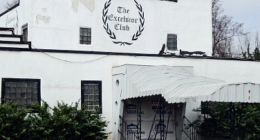
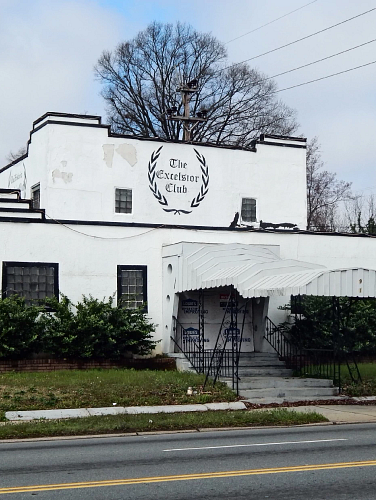
**CHARLOTTE: ** The Excelsior Club site has a new owner. On Oct. 27, the nonprofit Historical Excelsior purchased the Beatties Ford Road property from Kenwood Investments for $1.7 million, a transaction reported by local business press three days later.
The sale moves an $8.3 million redevelopment plan closer to construction. It does not mean the new Excelsior is built, or that the project’s full timetable and funding are settled. The original building was demolished in July after engineering assessments found it unsalvageable. A land-development construction permit was filed in early October. Current reporting points to construction beginning late this year or in early 2027, with completion targeted for 2028.
For Beatties Ford Road, the change is both concrete and incomplete: the land where a major Black social and cultural institution stood is now held by a nonprofit named for that history. What follows will determine whether the site again serves as a gathering place for the community that gave the club its importance.
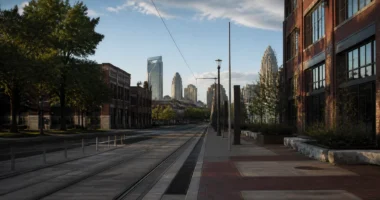
The Excelsior’s significance was visible on Oct. 17, when Johnson C. Smith University’s Homecoming parade passed the club’s footprint. In Metro Record Charlotte’s report from the parade, the route and the site were part of the same west Charlotte landscape: a campus, a historic Black institution and a corridor shaped by generations of Black community life. JCSU’s 2026 Homecoming information records the university’s celebration and game that day. Metro Record’s earlier coverage of development around Five Points examined other pressures changing this part of the West End.
The club opened in 1944, founded by Jimmie and Minnie McKee. It became one of the Southeast’s leading private social clubs for Black patrons, at a time when segregation restricted where Black Charlotteans could gather, celebrate and conduct business. Its stage hosted Louis Armstrong, James Brown, Sam Cooke and Nat King Cole. The club was listed in the Green Book from 1963 to 1967, when Black travelers relied on the guide to find places where they could safely stay, eat and socialize. The North Carolina African American Heritage Commission’s account traces that history.
The Excelsior was also a civic institution. Black professionals, civic groups and social organizations met there, and political candidates sought support from its patrons. Bill Clinton campaigned at the club in 1992. The Mecklenburg County Historic Landmarks Commission documents the McKees’ role in building a place that joined entertainment with political and community life.
That history explains why a new owner and a construction permit carry more weight than a routine property transaction. But ownership alone cannot restore what the club represented. The test will be whether the rebuilt site makes room for the people and institutions that sustained its legacy.
What the $8.3 million covers
The $1.7 million sale price is the amount paid for the property. It is not the full cost of redevelopment. The broader project is described as an $8.3 million plan for a near-replica of the historic club, with a live-performance venue, restaurant, rooftop seating and community space.
The City of Charlotte says it and Mecklenburg County each committed $1.5 million toward the project, for $3 million combined in public funding. The city’s project announcement described the remaining $5.3 million as private and philanthropic support. That announcement also set out conditions: city funding would follow construction milestones, plans would require review by the Charlotte-Mecklenburg Historic Landmarks Commission, and the developers would provide annual impact reports for up to 10 years.
Those commitments establish a framework for public oversight. They do not answer every current question about money. The Oct. 27 purchase confirms that Historical Excelsior acquired the land; it does not, by itself, show how much of the remaining project funding is committed, what has been spent beyond the acquisition, or whether the budget has changed. Those updated figures remain to be shown.
The city’s approved rezoning petition identifies a live-performance venue and nightclub as intended uses. The petition record places the site west of Beatties Ford Road. The historic club is commonly identified at 921 Beatties Ford Road; planning documents use 913 Beatties Ford Road for the parcel. The difference reflects the addresses used in separate records, not a second project.
There is also a timetable to clarify. Recent reporting puts construction at late 2026 or early 2027 and completion in 2028. The city’s November 2025 announcement projected construction beginning in 2027 and completion in late 2029. The newer target may reflect changes in the project schedule, but the public record reviewed for this story does not reconcile the two estimates. Construction has not begun, and the projected dates remain targets.
A corridor’s memory, and its next use
Beatties Ford Road carries more than traffic through west Charlotte. Black-owned businesses, churches, schools and civic organizations helped make the corridor a center of community life. Redlining and disinvestment constrained growth and access to resources, while new development now brings questions about who benefits from investment and who retains a place in the changing neighborhood.
The Excelsior was one of the corridor’s cultural anchors. Its importance came not only from the names on its stage, but from the everyday uses that drew people there: meetings, celebrations, political conversations and a chance to gather in a space created for Black Charlotteans. Rebuilding its façade and entrance can recall that history. Programming, access and stewardship will determine whether the new institution carries it forward.
The plans described by the city include live music, community events and free event space for local organizations. Those are commitments worth tracking alongside the construction schedule. Who will be able to reserve the space? How will local groups, artists and residents shape programming? What will access cost? And how will the promised impact reports measure whether the site serves the surrounding community?
For now, the known facts are a land purchase, an approved rezoning, a filed construction permit and a project plan backed by public commitments and expected private and philanthropic support. The open questions concern the final financing picture, the schedule and the community’s role in the finished venue. The sale is a step forward. It is not the same as a reopened club.
Readers with memories of the Excelsior Club are invited to share them with Metro Record Charlotte. Those experiences can help document what the building meant to the people who made it a landmark, and what a new Excelsior would need to mean to the generations who did not know the original.