
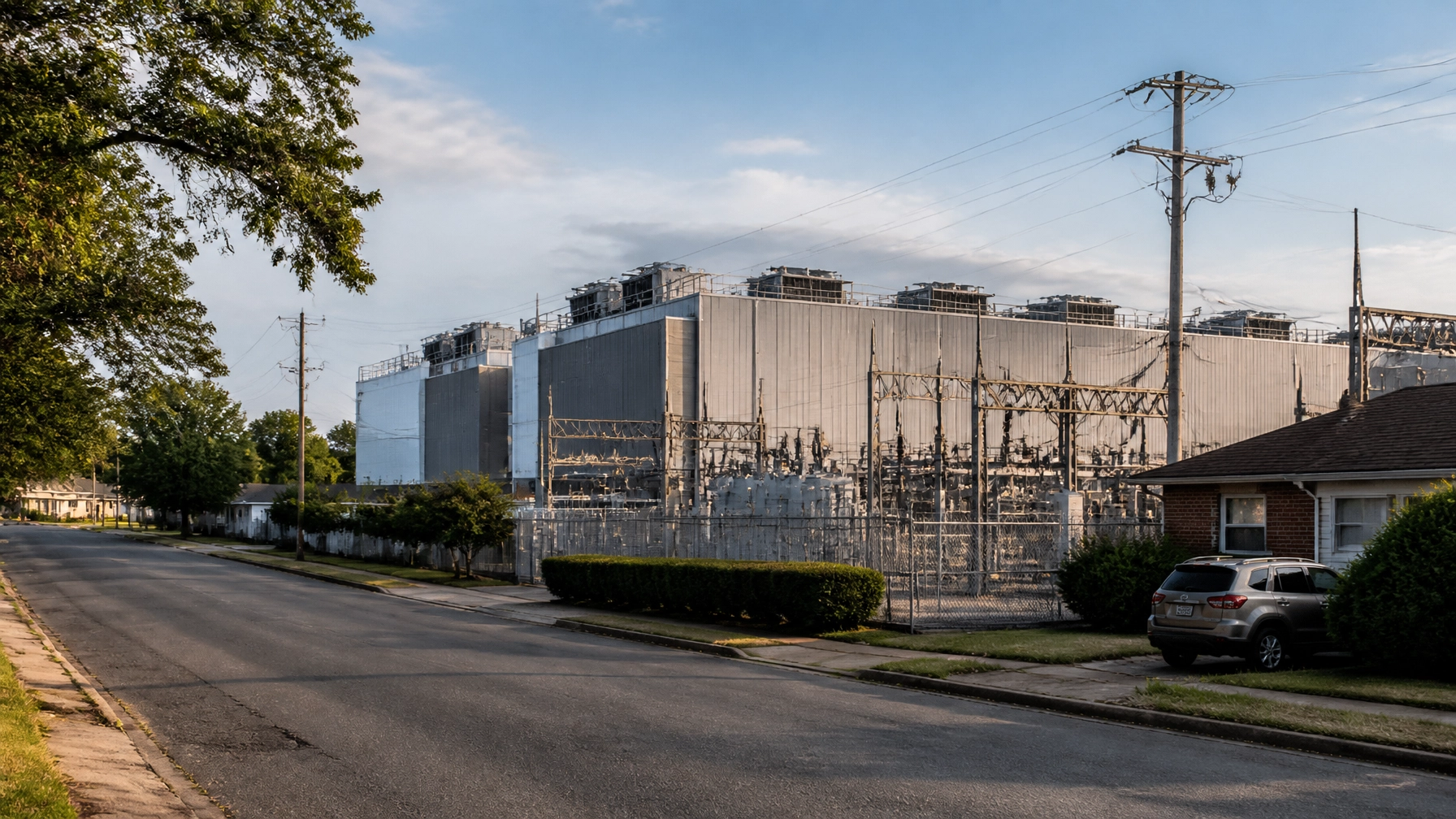

**CHARLOTTE, N.C. : ** Charlotte’s debate over data centers is moving toward a second decision point. The City Council’s transportation and development committee approved a request Tuesday to extend the city’s existing 150-day moratorium on new data-center development by up to nine months. The full council is scheduled to vote Sept. 14, ahead of the current moratorium’s expiration in early November.
The proposed extension would give city staff more time to develop rules for air-pollution monitoring, noise limits, water use, electric-grid capacity, project siting and community protections.
The central question is not whether Charlotte will use more digital infrastructure. It is who will absorb the costs of building it: and who will receive the benefits.
Charlotte already has about 40 operating data centers, according to Data Center Map, a third-party industry database. The number varies depending on whether a source counts the city, the broader metropolitan area, planned facilities or only operating sites. The proposed projects would add a different scale of industrial demand, particularly for electricity, land and cooling resources.
What the moratorium does: and does not do
The moratorium pauses the acceptance, processing and approval of new data-center development applications. It does not stop facilities that were already approved or under construction when the moratorium began.
That means Digital Realty’s facility on Moores Chapel Road and PowerHouse’s University City project can continue. The pause is aimed at future development and gives Charlotte officials time to establish a policy framework before additional applications move forward.
The distinction matters. Residents who expected the moratorium to halt all data-center construction may see work continue near their communities. At the same time, the city is attempting to determine whether existing zoning, environmental review and utility rules are sufficient for future projects.
City staff and a data-center task force are expected to develop policy recommendations through the extended review. The city has also announced community feedback sessions as part of its engagement process. Those sessions will determine whether residents have meaningful influence over the rules or are simply being asked to respond after major land-use decisions have already been made.

Water use is only part of the resource debate
The most visible comparison involves reclaimed water.
PowerHouse’s University City facility plans to use about 1.2 million gallons of reclaimed water daily. Digital Realty’s Moores Chapel site is reported at about 35,000 gallons daily. The difference reflects the size of the facilities and their cooling systems, not necessarily a universal standard for the industry.
A data center’s direct water use can vary widely. Some cooling systems rely more heavily on water, while others use air or hybrid systems. Daily consumption can also change with weather, equipment design and operating conditions.
Those direct-use numbers do not capture the full water demand associated with electricity generation. Data centers require substantial power to run computer servers and cooling systems. Power plants may use water to generate and cool that electricity. As a result, a facility can place pressure on the region’s water resources even when its on-site water use appears limited.
That distinction has become part of the city’s broader review. Charlotte Water officials have said residential customers will not be placed behind data centers during shortages. But residents and environmental advocates are asking whether the city has enough information to measure both direct and indirect demand during drought conditions.
The question is also financial. If the region needs additional modeling, monitoring or utility upgrades to accommodate large industrial users, those costs should be identified before approvals are issued. A promise to protect residential service is not the same as a public accounting of who pays for the infrastructure required to maintain it.
The grid question reaches beyond one facility
Electricity demand is another unresolved issue. Hyperscale data centers can require hundreds of megawatts of capacity. Digital Realty’s proposed Moores Chapel campus includes a new Duke Energy substation, while PowerHouse’s University City project also involves major power infrastructure.
Industry representatives argue that data centers are part of the digital systems Charlotte already depends on. During a town hall reported by WFAE, a representative for PowerHouse said the facilities support digital infrastructure, including healthcare services. That argument carries weight in a region that wants to attract technology companies and maintain reliable online systems.
But reliability has a cost. New substations, transmission capacity, road improvements and utility planning may benefit the broader system, or they may primarily serve a small number of high-demand customers. Residents and officials are asking whether developers will cover those costs in full, whether other utility customers could see higher expenses, and how the city will enforce commitments over time.
The city’s review should make those obligations public. It should distinguish between infrastructure paid directly by a developer, infrastructure shared with other customers and costs that remain with taxpayers or ratepayers.
Jobs are part of the argument: but the numbers remain unclear
Supporters describe data centers as economic-development projects that bring construction work, technical positions, facilities management and security jobs. They also point to private investment, tax-base growth and the possibility of attracting companies that depend on large-scale computing capacity.
Those benefits should be tested against documented local commitments.
Public reporting reviewed for this article has not established a verified total for permanent local jobs at the two Charlotte projects. It has also not established how many jobs will go to Charlotte residents, how many will be accessible without specialized credentials, or what wage and training standards will apply.
The same questions apply to contracts. Will Black-owned and minority-owned businesses receive opportunities in construction, security, maintenance, transportation, food service and professional services? Will procurement goals be included in enforceable agreements, or will access depend on informal promises?
A project can generate substantial investment without distributing its benefits broadly. Charlotte’s policy should require developers to explain who will be hired, what training will be funded and how local businesses will compete for contracts.

Who gets protected from the impacts?
The debate has exposed a familiar problem in Charlotte urban development: the communities closest to industrial uses often have the least control over decisions that affect their daily lives.
Residents and advocates have raised concerns that future hyperscale facilities could be sited near historically Black and Brown communities or lower-income neighborhoods. They have not claimed that data centers are already lowering property values, and there is no basis to say that future facilities will definitely be placed in Black neighborhoods. Their concern is about the pattern of land-use decisions and the consequences if large facilities are approved near communities with less political and economic power.
Those consequences could include constant equipment noise, nighttime lighting, traffic from construction and maintenance activity, air pollution from backup generators, and pressure on surrounding land. Residents have also raised concerns about displacement, property values and the loss of generational wealth.
The policy question is therefore larger than a setback requirement. Who gets protected from noise, traffic, pollution and industrial land uses? Who has access to the public process before a site is selected? Who receives jobs and contracts? Who has the ability to challenge an approval?
For Black homeowners and minority communities, these questions are connected to accumulated wealth. A decision that changes the character of a neighborhood can affect more than immediate comfort. It can influence whether families can remain, whether property can be passed to the next generation and whether nearby businesses can continue operating.
Charlotte’s process should address those concerns directly rather than treating them as a separate equity discussion after technical rules are written.
The next test is accountability
The Sept. 14 vote will not decide every question about data centers. It will decide whether the city gets more time to answer them before allowing additional development to proceed.
That time should produce clear standards, not another round of general assurances. Charlotte needs measurable noise limits, transparent air-monitoring requirements, drought protections, public reporting on water use, and a plan for evaluating grid impacts. It also needs enforceable expectations for local hiring, minority-business procurement and community benefits.
The city should identify which neighborhoods are most exposed to potential impacts, publish the criteria used to evaluate sites and explain how residents can challenge incomplete information. The public process should include residents who live near proposed development: not only developers, utility representatives and institutional stakeholders.
For readers who follow Charlotte local news and Charlotte community news, the data-center debate is a test of how the city manages growth. For Charlotte, North Carolina news coverage, the issue also raises a broader question: Can the city attract advanced infrastructure without shifting the environmental, financial and neighborhood costs to residents with the least power to negotiate?
The answer will depend less on the size of the next investment than on the conditions Charlotte attaches to it.
Sources
- WFAE: “Data centers are not priorities over citizens”: Charlotte mulls policy as moratorium ticks away, Aug. 21, 2026
- WFAE: Charlotte could extend data center moratorium by nine months, Sept. 8, 2026
- City of Charlotte: Data Centers Moratorium FAQs
- City of Charlotte: Data Center Engagement Opportunities
- Bisnow: City Council mulls data center development amid Charlotte moratorium
- Bisnow: Charlotte town hall marks halfway point of 150-day data center moratorium





1 comment