Metro Record Staff
October 23, 2026
**CHARLOTTE: ** A decade after Mecklenburg County selected the Peebles Corporation to redevelop Brooklyn Village, the county is weighing a new proposal for part of the site. The Charlotte-based developer First and Early has a plan that keeps the same total square footage as the previous proposal but includes less office space and fewer apartments. It does not promise more housing.
The question before county commissioners is not only whether the project can move forward. It is what the county will require in return, and whether the redevelopment will recognize the Black neighborhood that urban renewal dismantled.
At a meeting Tuesday, Oct. 20, commissioners discussed the proposal. Some said they were pleased and that the county needs to move forward. Commissioner Susan Rodriguez-McDowell said she wants more affordable housing. Commissioner Arthur Griffin questioned how the plan would preserve Brooklyn’s legacy.
“What I would ask you to do in my three minutes is to figure what's meant by preserving Brooklyn's legacy. I don't see that anywhere,” Griffin said.
Commissioners are expected to vote in November, but the exact date and the terms they will be asked to approve remain unclear. The county has filed a lawsuit against Peebles over the other parcels in the project. It has not yet answered, in public contract language, Griffin’s question about what preservation means.
The Metro Record Charlotte is examining what is known about the new proposal, what remains unsettled and who has the leverage to shape the result. The current information establishes a new developer and a path toward a vote. It does not yet establish what affordability, business access or historical recognition the agreement will guarantee.
A decade without an apartment
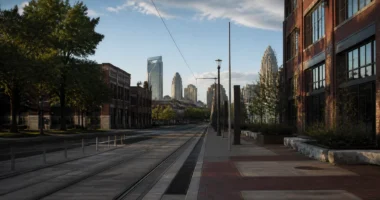
Mecklenburg County selected Florida-based Peebles Corporation in 2016 to redevelop Brooklyn Village in uptown Charlotte’s Second Ward. As WFAE reported, Peebles never built a single apartment. The company recently sold one parcel to First and Early, which has presented the new proposal.
Under that proposal, construction would begin three years after the county approves the deal. That is a timeline for a future start, not a building underway. After ten years, the distinction is consequential: residents have seen a plan change hands, but the site has remained a visible reminder of promises not yet realized.
The county’s 2023 announcement described the redevelopment as a multistage project intended to include housing, offices, a hotel, retail and park uses. That announcement followed the sale of the first-phase property. The proposal commissioners discussed this week is a new step, but it does not settle what the final project will deliver, or how the county will hold the developer to its commitments.
Brooklyn was not an empty site waiting for a new identity. The Levine Museum of the New South’s history of Brooklyn describes a 238-acre Second Ward neighborhood that was a cultural and economic center of Black Charlotte. It was home to Black-owned businesses, schools, churches, civic organizations and more than a thousand families. Urban renewal displaced residents and destroyed homes, businesses and institutions.
That history changes the measure of progress. A project can add commercial space and housing while leaving unanswered whether the people and businesses connected to Brooklyn have a place in its future. The open parcels and surface parking are not simply a development opportunity; they occupy land whose former community was forcibly dispersed.
Progress for whom, and on whose terms?
The county has an understandable institutional incentive to show movement. It selected a developer in 2016, watched a decade pass without an apartment being built and is now pursuing litigation over other parcels. In an election-year November, approving a new deal could allow officials to point to forward motion.
But a vote is not the same as accountability. The terms of that vote will determine whether “moving forward” means a binding set of public obligations or mainly a new timetable and a new developer. The strongest claim to the land belongs to people whose neighborhood was destroyed and whose families were displaced. They have the least direct leverage over the county’s negotiations unless their priorities are written into the agreement.
The same-square-footage proposal changes the mix: less office space and fewer apartments. That may alter the project’s balance, but it does not answer whether it creates more housing or who will be able to afford it. Rodriguez-McDowell’s call for more affordable housing puts a central question on the record. The county still needs to identify the affordability levels and income bands the new plan would carry, and explain how they compare with its original promises.
The questions extend beyond housing. The proposal needs to make clear whether it includes commitments for minority-owned and Black-owned retail businesses, contracting, or both. Without enforceable terms, a reference to community benefit does not say who will receive leases, contracts or a lasting economic stake.
And the county’s litigation with Peebles remains part of the public account. The county has filed suit over the other parcels; the status and scope of that case are still awaited. Those answers matter to understanding what land remains under dispute, what the county is seeking and how the case may affect the broader project. They should not be inferred from the proposal for the parcel sold to First and Early.
What the November vote must clarify
Before commissioners vote, residents should be able to see the exact date and the full terms under consideration. They should be able to tell which commitments are binding, which depend on later negotiations and what happens if construction does not begin on schedule.
The county should also explain how affordability will be defined: the number or share of units, the income bands served, and how long affordability would be maintained. The public cannot compare a new plan with earlier promises if the county does not set out both in clear, comparable terms.
The business commitments require equal clarity. If Black-owned and minority-owned businesses are to participate, the agreement should specify the form of participation and how it will be measured. If no such commitment exists, that should be stated plainly.
Most of all, the county needs to answer Griffin’s question in language that can be enforced. What does preserving Brooklyn’s legacy mean in the contract? Does it mean historical interpretation, space for businesses, specific community benefits, or something else? The public has not yet been given an answer that can be evaluated against the agreement itself.
This is the inquiry The Metro Record Charlotte will continue to pursue: what information the county has put forward, what it has yet to disclose and whether the final deal ties the language of legacy to obligations that survive the vote. Updates and related coverage will be published at metrorecordclt.com.
People who lived in Brooklyn, or whose families did, are invited to contact the newsroom through Metro Record Charlotte’s contact page. Share what you remember about the neighborhood and what you want to see built on its land.