

By The Metro Record Charlotte
September 9, 2026
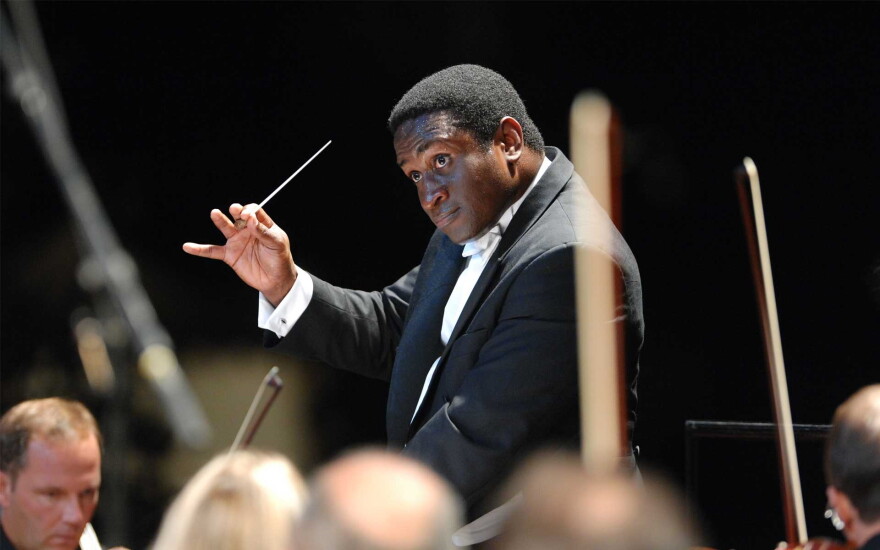
CHARLOTTE, N.C. : Kwamé Ryan will lead the Charlotte Symphony through one of the most consequential milestones in the orchestra’s history.
The orchestra announced Tuesday that Ryan has signed a four-year contract extension that will keep him as music director through its 100th anniversary season in 2031–32. He began his Charlotte tenure in 2024, and the extension gives the organization several years to develop the artistic direction, audience relationships and institutional ambitions that will define its centennial.
The decision follows a period of visible momentum. Under Ryan’s leadership, the Charlotte Symphony has returned to national broadcasts, expanded its programming around living composers and completed a $50 million fundraising campaign, according to WFAE’s report.
Ryan also won the 2026 Grammy Award for Best Opera Recording for Houston Grand Opera’s recording of Jake Heggie’s Intelligence. The award made him the first Charlotte Symphony music director to win a Grammy.
The extension recognizes those accomplishments. It also places Ryan at the center of a larger question: What should a major orchestra in Charlotte become as the city changes around it?
A conductor with a broader artistic horizon
Ryan brings an international career and a wide musical vocabulary to Charlotte. His work has included opera, symphonic music, music education and performances with leading orchestras in the United States and Europe. The Charlotte Symphony’s official biography describes a conductor whose career has moved across institutions, countries and musical traditions.
That range matters to an orchestra seeking a stronger place in the cultural life of a growing city.
Classical institutions can become isolated when their programming is treated as a fixed inheritance rather than an evolving conversation. Ryan’s focus on living composers creates an opportunity to make the orchestra more responsive to the present. New work can address current histories, communities and questions in ways that older repertoire cannot always do on its own.
The orchestra’s published plans already point in that direction. Its 2026–27 season includes a world premiere inspired by the life and work of civil rights leader John Lewis, alongside major works by composers including Beethoven and Tchaikovsky. That combination suggests a useful approach for the anniversary era: preserve the strongest parts of the canon while widening the range of voices and experiences represented on stage.

An orchestra’s next chapter will be measured not only by its programming, but also by who can see a place for themselves in the institution.
Ryan’s programming can help move classical music beyond the assumption that its audience is already defined. That means presenting new composers alongside familiar works, building stronger connections with schools and neighborhood organizations, and making performances feel relevant to people who have not traditionally viewed the concert hall as their cultural space.
The challenge is not to make classical music less serious. It is to make the institution more open to the city it serves.
Representation is part of the institution’s future
Ryan is the first Black conductor to lead the Charlotte Symphony. That fact carries significance in a field where Black conductors remain underrepresented in music-director positions across the country.
His appointment gives Charlotte an important form of visibility. Young Black musicians can see a Black artist directing one of the city’s major cultural institutions. That visibility can influence whether students imagine conducting, composing or orchestral performance as part of their future.
Ryan has spoken about the representation challenges facing Black conductors and about the importance of inspiring the next generation. In interviews, he has described the limited visibility of Black conductors as a problem that can reinforce itself over time: If young people rarely see someone who looks like them on the podium, fewer may understand that the position is open to them.
His Grammy win reinforced that message. In remarks following the award, Ryan emphasized the significance of moments that can inspire future generations of Black musicians. The achievement belongs to him as an artist, but its meaning extends beyond a single career.
Representation, however, cannot end with one historic appointment.
The Charlotte Symphony has not solved every question involving access, audience development or institutional diversity. Ryan’s presence creates an opening, but the organization’s broader responsibility will be to build pathways around it. That includes sustained music education, partnerships with Black and minority communities, opportunities for emerging musicians and programming that reflects the range of Charlotte’s cultural life.

Meaningful access requires more than visibility. It requires relationships, instruction and clear opportunities for participation.
The orchestra’s centennial period should therefore be evaluated by more than attendance figures or the prestige of its guest artists. It should also be judged by who is learning an instrument, who is being commissioned, who feels welcome at a performance and who can imagine a future inside the institution.
Those questions are especially relevant in a city where Black residents have shaped the cultural identity of Charlotte for generations, even as major arts institutions have not always reflected that influence in leadership, programming or audience composition.
Bringing the orchestra closer to Charlotte
Ryan has said Charlotte has become his second home and that he looks forward to continuing his work with the orchestra. His extension gives that statement an institutional dimension. He will have time to deepen relationships rather than simply introduce a new artistic agenda and move on.
That continuity matters. Building trust with audiences takes longer than announcing a new season. It requires repeated contact, listening and an understanding of the communities beyond the traditional subscription base.
The orchestra can use the next six years to expand where and how it performs. Concert halls will remain central, but they do not have to be the only places where Charlotte Symphony musicians engage the public. Schools, churches, libraries, parks, neighborhood cultural centers and community events can all serve as points of connection.
The question is not whether every performance must be designed for everyone. It is whether the institution is willing to recognize that Charlotte’s audiences are not limited to the people who have historically filled its seats.

Charlotte’s cultural institutions are increasingly being asked to connect their stages to the broader civic life of the city.
Ryan’s leadership also arrives at a moment when Charlotte is competing for national attention as a center of business, culture and population growth. The return to national broadcasts gives the orchestra a larger platform, while the completed fundraising campaign provides resources for artistic and community work.
Money and visibility create capacity. They do not determine how an institution uses it.
The extension offers the Charlotte Symphony an opportunity to define success in broader terms. A strong centennial season should be artistically ambitious, but it should also communicate why the orchestra belongs to Charlotte: not as a private institution for a narrow audience, but as part of the city’s shared cultural infrastructure.
That work will include honoring the composers and musicians who built the orchestra. It should also include questioning which stories have been left out and which audiences have been treated as peripheral.
A centennial with room to grow
The Charlotte Symphony’s 100th anniversary will arrive with Ryan still at the podium. His Grammy, international reputation and first years in Charlotte have already established a significant foundation.
The next phase will test whether that foundation can support a more expansive institution.
Ryan’s extension is worth celebrating because it gives Charlotte a conductor with demonstrated artistic ambition and a record of achievement. It is also worth examining because leadership changes are most meaningful when they influence the structures around them.
For Charlotte’s arts community, the opportunity is clear: broaden the canon, support living composers, create more entry points for young musicians and build genuine relationships with Black and minority communities across the region.
The centennial should not be treated as a finish line. It should be a measure of how well the orchestra understands the city it represents and how seriously it intends to serve the one it is becoming.
For readers following charlotte nc culture and charlotte local news, Ryan’s continued leadership gives the Queen City a cultural story with both immediate significance and long-term consequences. The podium is occupied. The larger work is still ahead.
Sources: WFAE; Charlotte Symphony newsroom; Kwamé Ryan biography; The Metro Record Charlotte.