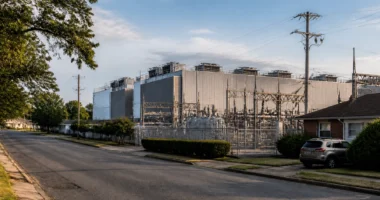


Illustrative image. The photograph does not depict Jackson, Mississippi, or Charlotte, North Carolina.
By The Metro Record Staff
Published September 13, 2026
**JACKSON, Miss. : ** A federal appeals court has ruled that residents do not have a specific constitutional right to contaminant-free municipal drinking water or to truthful information from public officials during a public-health crisis.
The Sept. 4 en banc decision in Sterling v. City of Jackson affirmed the dismissal of federal civil-rights claims brought by Jackson residents who alleged that city officials knew lead had entered the water system and still reassured the public that the water was safe.
The ruling is significant, but its reach is limited. The Fifth Circuit’s decision binds federal courts in Mississippi, Louisiana and Texas. It is not a nationwide ruling by the U.S. Supreme Court, and it does not eliminate federal or state drinking-water laws, regulatory duties or other possible legal remedies.
The case arose from Jackson’s long-running water crisis, which included treatment failures, contamination concerns, repeated boil-water notices and a 2022 breakdown that left many residents without reliable running water. Jackson is a majority-Black city whose residents experienced the effects of years of infrastructure problems and political disputes over funding, oversight and control.
The court’s majority framed the issue narrowly. It asked whether the Fourteenth Amendment’s substantive due-process protections include a historically rooted right to be free from government-caused exposure to contaminated municipal water, or a right to receive accurate information from officials about that contamination.
The majority concluded that they do not.
What the Fifth Circuit decided
The residents sued under Section 1983, a federal law that allows people to seek damages when government officials violate constitutional rights. They argued that exposure to lead-contaminated water implicated the right to bodily integrity and that officials’ alleged misrepresentations created a separate constitutional injury.
The en banc majority rejected both theories as presented.
The judges distinguished the allegations from established bodily-integrity cases involving forced medical treatment, physical assault or other direct intrusions on a person’s body. The majority said that municipal mismanagement resulting in exposure to contaminated water, however serious, did not fit within the historically recognized constitutional right.
The court also rejected the argument that the Constitution guarantees truthful information from public officials about contamination. The majority acknowledged that accurate information would have helped residents make decisions about whether to drink the water. It nevertheless found no sufficiently established constitutional right to truthful government statements during a public-health emergency.
That holding does not mean officials may lawfully provide contaminated water, mislead residents or ignore safety requirements. It means those alleged actions do not, under the majority’s analysis, create the particular type of substantive-due-process claim the residents brought under Section 1983.
Five judges dissented in part. The dissent argued that the residents had plausibly alleged violations of bodily integrity and should have been allowed to pursue discovery. It also criticized the majority for failing to address the state-created-danger theory more fully. That disagreement reflects an important legal question: whether a government’s affirmative actions that increase a person’s exposure to danger should be treated differently from a failure to provide a public service.
The majority did not resolve that question in the residents’ favor.

Illustrative environmental image. The facility is not identified as a Jackson or Charlotte water plant.
The ruling does not erase water-safety protections
The Constitution is only one source of protection.
The Safe Drinking Water Act remains in force. So do state water-quality laws, administrative enforcement powers, public-notice requirements and regulatory standards. Depending on the facts, residents may also have access to state-law tort claims, contract claims, administrative complaints or other statutory remedies. Each route has its own requirements, defenses and limitations.
The federal response to Jackson shows the difference between constitutional liability and regulatory accountability.
In 2022, the Justice Department filed a complaint on behalf of the Environmental Protection Agency alleging that Jackson had failed to provide drinking water reliably compliant with the Safe Drinking Water Act. A federal court approved an interim order that placed the system under an interim third-party manager and established priority projects for stabilizing treatment plants and distribution infrastructure.
EPA reports that it awarded more than $148 million through emergency grant authority. More than $100 million was directed toward work including leak repairs, pressure improvements, valve and hydrant assessments and other critical repairs. Additional federal and state revolving-fund support has been directed toward treatment plants and distribution-system improvements.
EPA’s current materials also describe continuing work on corrosion control, winterization, valves, pipes and hydrants. The agency says repairs have improved reliability, but it also acknowledges that additional work is needed to establish long-term stability.
Those interventions addressed an urgent public need. They did not settle every question about how the crisis developed, who made key decisions, whether residents received timely information or how control of the system should be structured. Infrastructure investment and accountability are related but separate responsibilities.
Race, power and the limits of legal remedies
The ruling arrives in a city where race and public investment cannot be separated from the water crisis.
Jackson’s population is majority Black, and residents have described the water emergency as the product of years of disinvestment, weak oversight and limited political power. The Fifth Circuit’s opinion did not decide whether racial discrimination caused the crisis. It addressed only the constitutional claims before it.
That distinction also matters when considering the EPA’s prior civil-rights review. The EPA Office of Civil Rights found insufficient evidence that intentional racial discrimination shaped Mississippi’s distribution of water-system funding. That administrative finding was not a determination that Jackson’s residents had not experienced unequal consequences, nor was it a ruling on the constitutional claims in Sterling. The two proceedings examined different questions under different legal frameworks.
The relevant federal civil-rights framework is Title VI of the Civil Rights Act of 1964, not 1965. Title VI addresses discrimination based on race, color or national origin in programs receiving federal financial assistance. Its enforcement standards and administrative processes are distinct from the substantive-due-process theory rejected by the Fifth Circuit.
National research places Jackson’s experience within a broader pattern without making every water system equivalent.
An EPA report to Congress found that Black communities were more likely than white communities to be served by community water systems with health-based Safe Drinking Water Act violations. Other studies have found that systems serving communities with larger Black populations can remain out of compliance longer. These are national patterns, not proof that every majority-Black city has unsafe water or that race alone explains a particular violation.
The concern is that constitutional limits matter most where residents already face weaker institutional protection. When a community has experienced decades of underinvestment, a narrow legal remedy can leave residents dependent on agencies, elected officials and regulatory systems that may have failed to act earlier.
What Charlotte should learn from Jackson
Charlotte is not Jackson, and available official materials do not show that Charlotte Water is experiencing a comparable crisis.
Charlotte Water’s 2025 drinking-water materials report zero current drinking-water violations and say the system meets state and federal standards. The utility also operates Lead Free CLT, conducts lead sampling, maintains a service-line inventory and provides public education about lead risks. Its published materials say no lead pipes have been identified in the Charlotte Water network to date, and that the initial inventory found no lead private service lines in the community.
Those findings should be stated clearly without turning compliance into a reason to stop asking questions.
For Charlotte residents, the relevant standard should include more than the absence of a reported violation. When water quality, lead, PFAS, service interruptions or infrastructure risks are at issue, residents should be able to expect timely notice, accessible data, language access, plain explanations and a clear path to accountability.
That is a question for Charlotte local politics as much as for utility management. It concerns who receives information, how quickly officials disclose uncertainty and whether residents can participate in decisions affecting their health and neighborhoods.
The distinction between municipal systems and private wells is also essential. Charlotte Water is a regulated public utility that tests and reports on its system. Private-well owners are generally responsible for testing and treating their own water.
A UNC-Chapel Hill study reported by WFAE found that 67% of sampled private wells in four North Carolina counties exceeded at least one state or federal guideline for a contaminant. White, higher-income well users were 10 times more likely to have tested their wells and four times more likely to have treated their water than lower-income users and people of color.
Those findings apply to private-well users in the study area. They should not be transferred to Charlotte Water’s municipal system. They do show how income, race and access to information can determine who is able to identify and address a water problem.
For Charlotte community news and charlotte north carolina news, that is the local connection: public safety depends not only on technical standards, but also on whether residents can understand the data and obtain a response when something appears wrong. Strong charlotte local news should examine both the published results and the systems behind them.
Where Charlotte residents can find information
Residents can review Charlotte Water’s Water Quality page, which includes annual reports and consumer information. The city’s 2025 Drinking Water Quality Report includes information about testing, violations, lead monitoring and Lead Free CLT.
Charlotte Water’s 2025 Annual Report provides additional information about the service-line inventory and program work. Residents with questions about lead testing or water quality can contact Charlotte Water through 311 or 704-336-7600. Current service notices and emergency information should be verified through official Charlotte Water and city channels.
The practical lesson from Sterling is not that water laws are meaningless or that residents have no recourse. It is that constitutional law may provide a narrower remedy than residents expect when public systems fail.
That makes statutory enforcement, public records, accurate alerts, accessible data and local political accountability more important; not less.
Source note
This article is based on the Sept. 4, 2026 en banc opinion in Sterling v. City of Jackson, Capital B’s reporting on Jackson’s water crisis and the EPA civil-rights finding, EPA’s Jackson drinking-water materials, the Justice Department’s 2022 Jackson water filing, Charlotte Water’s official quality information, its 2025 water-quality report, the 2025 annual report and WFAE’s report on the North Carolina private-well study.