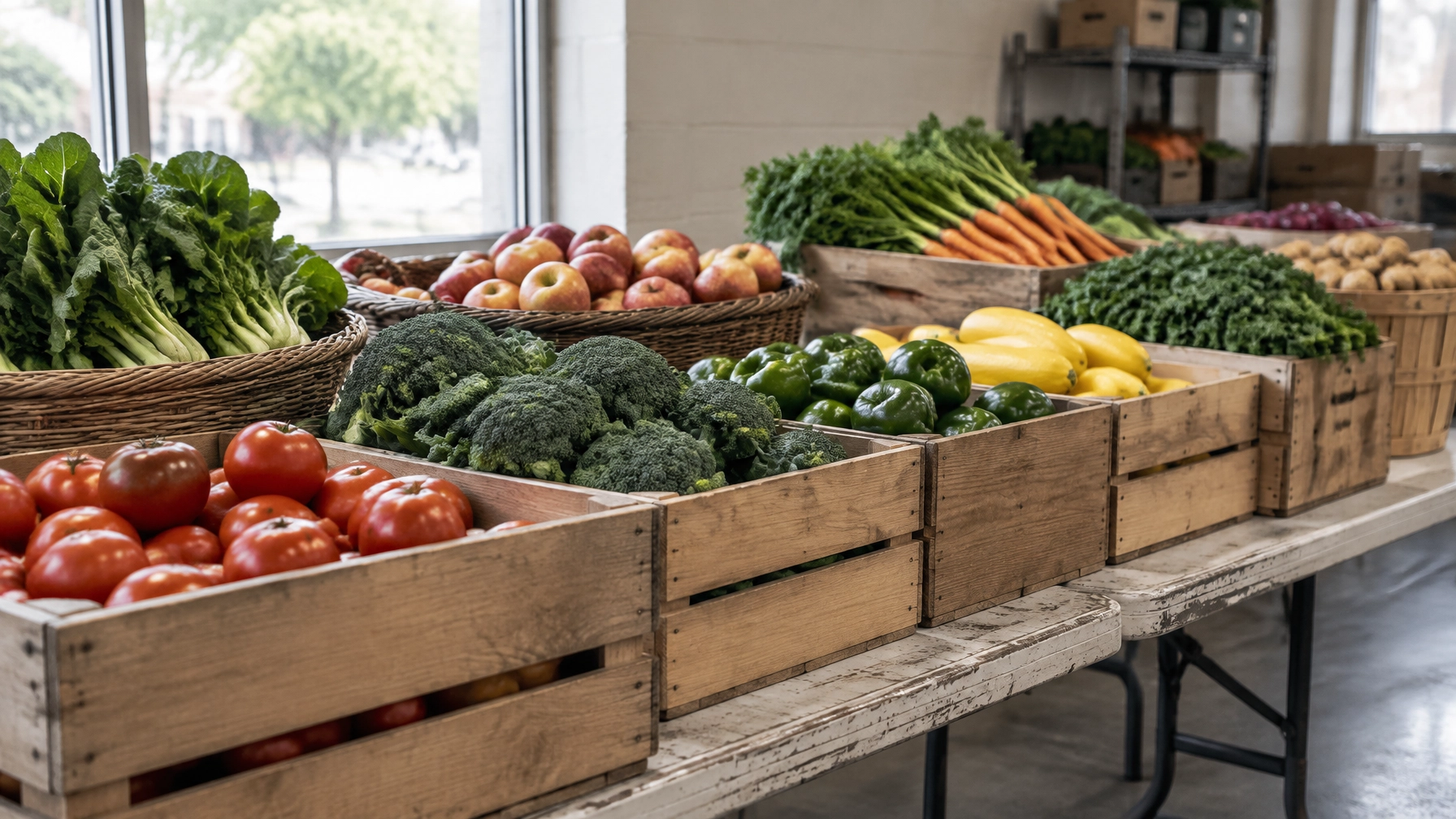

Illustrative image generated for The Metro Record; no identifiable people depicted.
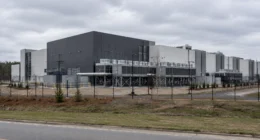
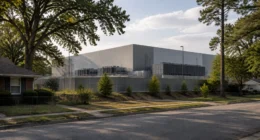
**CHARLOTTE: ** Carolina Farm Trust raised a little more than $12 million to build a food distribution center and grocery store in Thomasboro-Hoskins, a historically Black west Charlotte neighborhood where residents still lack convenient access to a full-service grocery.
The city provided $1.5 million in federal COVID-19 relief funds administered locally. Mecklenburg County added $6.7 million from the same federal relief pool, also administered locally. According to WFAE’s reporting, those public awards were part of a total fundraising effort of a little more than $12 million. WFAE reported that most of the total went toward warehouse renovations and equipment costs. Metro Record has not independently verified that allocation. The composition of the remaining funds beyond the city and county awards has not been fully reported in the public accounts reviewed by Metro Record.
The grocery store never opened.
Instead, Carolina Farm Trust closed its farm stand, laid off staff, subleased its renovated kitchen to a catering company and shut down most of its operations in July 2026. The nonprofit is now trying to raise enough money to restart.
Nothing in the public record reviewed by Metro Record establishes fraud, misappropriation or a criminal offense. No charges have been filed, and the county’s audit has not been publicly released. But the project’s central promise remains unfulfilled, and the public has not yet received a detailed accounting of how the funds were used.
A grocery store promised to a neighborhood with few options
Carolina Farm Trust was founded in 2015 by Zack Wyatt, who serves as its founder, president and CEO. The nonprofit is headquartered in Cornelius and operates in Charlotte. Its stated mission includes protecting farmland, supporting local farmers and building sustainable food systems across the Carolinas.
The South Hoskins Road project was supposed to connect those goals to a neighborhood need.
Thomasboro-Hoskins has deep roots and a culture of neighbors helping neighbors. It is also a longstanding food desert. According to WFAE, just 3% of homes in the neighborhood are within a half-mile of a full-service chain grocery store.
Residents have only a few convenience stores and a Mexican tienda nearby. Many seniors must take a bus to shop for groceries. Beverly Knox Davis, founder of A Brighter Day Ministries, a food pantry less than half a mile from the project, said residents often walk to convenience stores on South Hoskins Road.
“You’re not going to get produce there,” Davis told WFAE.
A Brighter Day serves more than 80 people a day on a budget of less than $1 million. Three generations of women work at the pantry, which previously had a line that wrapped around the block.
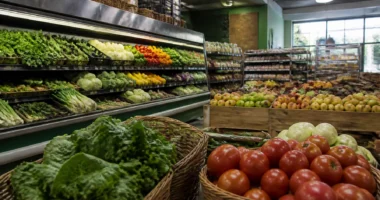
The proposed Carolina Farm Trust grocery store offered something different: fresh local produce within walking distance, a distribution center for farmers and a stronger local food economy.
“It just had us all dreaming what could be a part of this area,” Davis said.

Illustrative image generated for The Metro Record; no identifiable people depicted.
The farm stand was not the grocery store
The project produced a farm stand, but it did not produce the promised full-service market.
The stand operated only four hours a week. Residents complained about the quality of the food and considered it too expensive for the neighborhood. Davis described the produce as poor quality and “very overpriced for what this demographic could afford.”
When the hours did not expand and the grocery store did not materialize, residents became concerned.
Wyatt told WFAE that he understood he made mistakes with the farm stand.
“The responsibility ends with me,” he told WFAE. “We did not do a good job of rolling that out, managing it and making sure that the community was supported by it.”
Wyatt told WFAE the grocery store was part of a second phase that would require another $8 million. He told commissioners, “We have a shovel-ready project that will address this issue in eight months if it’s funded.”
Nearly 10 months later, the nonprofit’s GoFundMe had raised about $4,000 toward that phase and remained active as of publication.
WFAE reported that CFT also lost $2.5 million to federal budget cuts in 2025; Metro Record has not independently verified the scope of that reduction. Wyatt told WFAE he contacted three Mecklenburg County farms, but none sold produce through the organization.
“There has been no Mecklenburg County farmer that has approached Carolina Farm Trust or myself, asking to sell their stuff through us,” Wyatt told WFAE.
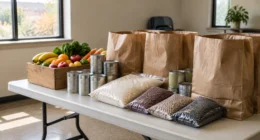
According to WFAE’s reporting, the nonprofit donated its old refrigerators to A Brighter Day Ministries. Davis said the equipment has been helpful. She also said Wyatt’s project brought hope to the neighborhood and that she still wants to see it succeed.
“Zack brought a lot of hope to a lot of people when it was all presented,” Davis said, “and I just want to see it happen the way that it was presented to all of us.”
Wyatt has said he plans to lease additional space in the warehouse before Carolina Farm Trust resumes operations.
That plan raises a basic question: what is the current purpose of a facility funded in part to serve residents and farmers in a neighborhood that still has no grocery store?
County officials questioned the project
Community concerns reached the Mecklenburg Board of County Commissioners. In November 2025, commissioners questioned Wyatt about the South Hoskins Road operation.
Commissioner Arthur Griffin said the distribution center “seems to be supportive of everybody else except the people in Hoskins.”
The county had submitted a $4 million proposal to U.S. Rep. Alma Adams on Wyatt’s behalf. The federal government approved $850,000.
After the commissioners questioned Wyatt, they asked Adams to withdraw the funding and launched a third-party review of Carolina Farm Trust’s South Hoskins Road financial practices, accounting, use of funds and compliance with grant terms.
In a letter to Adams, commissioners said they were no longer confident that CFT could deliver on its promises. They cited layoffs, high food prices and a “lack of benefit to farmers and local food producers within Mecklenburg County.” That funding decision followed commissioners’ stated concerns about delivery, farmer benefit and food prices, not race, even as the failed grocery promise landed in a historically Black neighborhood.
Wyatt told WFAE he did not know why officials chose to return the money.
County representatives declined an interview with WFAE. In a written response, county officials said they did not know Wyatt had stopped the farm stand or leased out the kitchen.
The audit has not been made public. Commissioners plan to review its results in closed session on Oct. 27, 2026.
Oct. 27, 2026: the next accountability checkpoint
The closed-session review is the next scheduled point at which commissioners will examine the audit’s findings. The outcome should not be predicted before the review occurs. North Carolina law permits a public body to meet in closed session only for purposes specified in G.S. 143-318.11(a), which include certain legal, personnel and privileged matters. Why this review will be discussed in closed session is a fair question for readers to ask.
Nothing in the public record reviewed by Metro Record establishes that any funds were misappropriated, diverted or stolen. Nothing in the public record reviewed by Metro Record establishes, and Metro Record does not report, that Wyatt or Carolina Farm Trust personally benefited from the funds.
Questions Metro Record is asking
- How were the more than $12 million in funds used, line by line?
- What did the audit find?
- Why will commissioners review the results in closed session?
- What happens to the warehouse, kitchen and equipment?
- What does Mecklenburg County owe a neighborhood that was promised a grocery store?
- Who is accountable when public money produces renovations and equipment but no grocery store?
Those questions are central to Charlotte community news because the project was not funded as a private experiment alone. Millions of public dollars were involved, and the project was located in a neighborhood with an established need.
A different model is moving slowly nearby
Three Sisters Market provides a useful comparison, although it is not an identical project.
The community-owned grocery cooperative was developed by the West Boulevard Neighborhood Coalition. The coalition received a $1.5 million City of Charlotte award approved in 2023. That city award is separate from private Wells Fargo support. Three Sisters has also received significant private support.
The Charlotte Urban Institute reported in April 2026 that Wells Fargo announced a broader $6 million investment involving several West Boulevard organizations. The Charlotte Post reported that $1.5 million of Wells Fargo funding was directed to the coalition. Those figures should not be combined without clarification: one account describes a broader $6 million investment involving several West Charlotte organizations, while another identifies $1.5 million as the amount directed to the coalition.
Three Sisters has not opened. Its groundbreaking has been reported as scheduled for October 2026. It is a slower project, developed through a neighborhood coalition and structured as a cooperative with community ownership and governance.
That structure may matter more than the difference in timelines.
Carolina Farm Trust raised more money faster and produced less. Three Sisters has moved slowly but remains active, with a community-based governance model and a reported construction schedule. Both projects address food access in west Charlotte, but they are different organizations with different structures.
The comparison is not proof of intent or bias.
The question is becoming more consequential as the city and NCDOT implement the I-77 South community benefits agreement. The agreement includes funding for nonprofit-built grocery stores, with West Boulevard and Statesville Avenue identified among the possible locations. Reports have differed on how the $300 million package is divided, so the specific grocery allocation should not be stated as settled without additional documentation.
Charlotte’s future food projects will require more than announcements and capital commitments. They will require clear benchmarks, public reporting and governance structures capable of keeping the neighborhood’s needs at the center.

Illustrative image generated for The Metro Record; no identifiable people depicted.
What we have
More than $12 million was raised in total, including $1.5 million from the city and $6.7 million from Mecklenburg County in federal COVID-19 relief funds administered locally rather than locally generated revenue. The composition of the remainder has not been fully reported in the public record reviewed by Metro Record.
What is publicly clear is that the grocery store did not open, the farm stand closed, and the audit has not been released. What is not yet publicly clear is how the money was used in full detail, what the county’s review found, and what comes next for the warehouse, kitchen and equipment.
Different stories draw different amounts of public attention. For Metro Record Charlotte, which is a new publication roughly three weeks old, this is part of what we are here to do: ask straightforward questions, be clear about what we can confirm, and keep following the story as more information becomes available.
What we are waiting for
The next public checkpoint is Oct. 27, 2026, when commissioners are scheduled to review the audit results in closed session.
Until that review happens, and until more records or responses are made public, several basic questions remain open: how the public funds were used in detail, what the audit found, and what accountability or next steps county officials may outline afterward.
Metro Record will report the audit’s outcome after commissioners review it on Oct. 27, 2026. We will keep asking what happened to the public funds and publish what we learn.
Sourcing and method
This article relies substantially on WFAE’s Sept. 2, 2026 reporting and on publicly available records and statements. Metro Record has not independently reviewed the underlying grant agreements, invoices or the county’s audit.
Metro Record contacted Carolina Farm Trust, CEO Zack Wyatt, Mecklenburg County, the City of Charlotte and Rep. Alma Adams’ office seeking comment and had not received a response from those parties by publication time. County representatives declined an interview with WFAE.
Metro Record Charlotte is a new publication, roughly three weeks old, and this article is part of a continuing effort to follow the questions it raises.
Sources
Note: The requested stored title-field change cannot be verified or applied from the markdown body alone. The on-page H1 is already set to: “$12 Million Was Raised to Fix a West Charlotte Food Desert. The Grocery Store Never Opened.” The stored title field should be updated in the publishing system to exactly match that text, and the word “Went” should not appear there.
- WFAE: West Charlotte grocery project stalls, despite $12 million in federal grants
- Charlotte Urban Institute: $6M Wells Fargo investment advances Three Sisters Market
- WCCB: Wells Fargo invests in West Boulevard corridor
- City of Charlotte: The story of the Three Sisters Market
- WFAE: City Council approves $1.5 million funding for Three Sisters Market
- The Charlotte Post: Charlotte food cooperative key to West Boulevard growth
- Business North Carolina: Food co-ops still on the I-77 menu

1 comment