
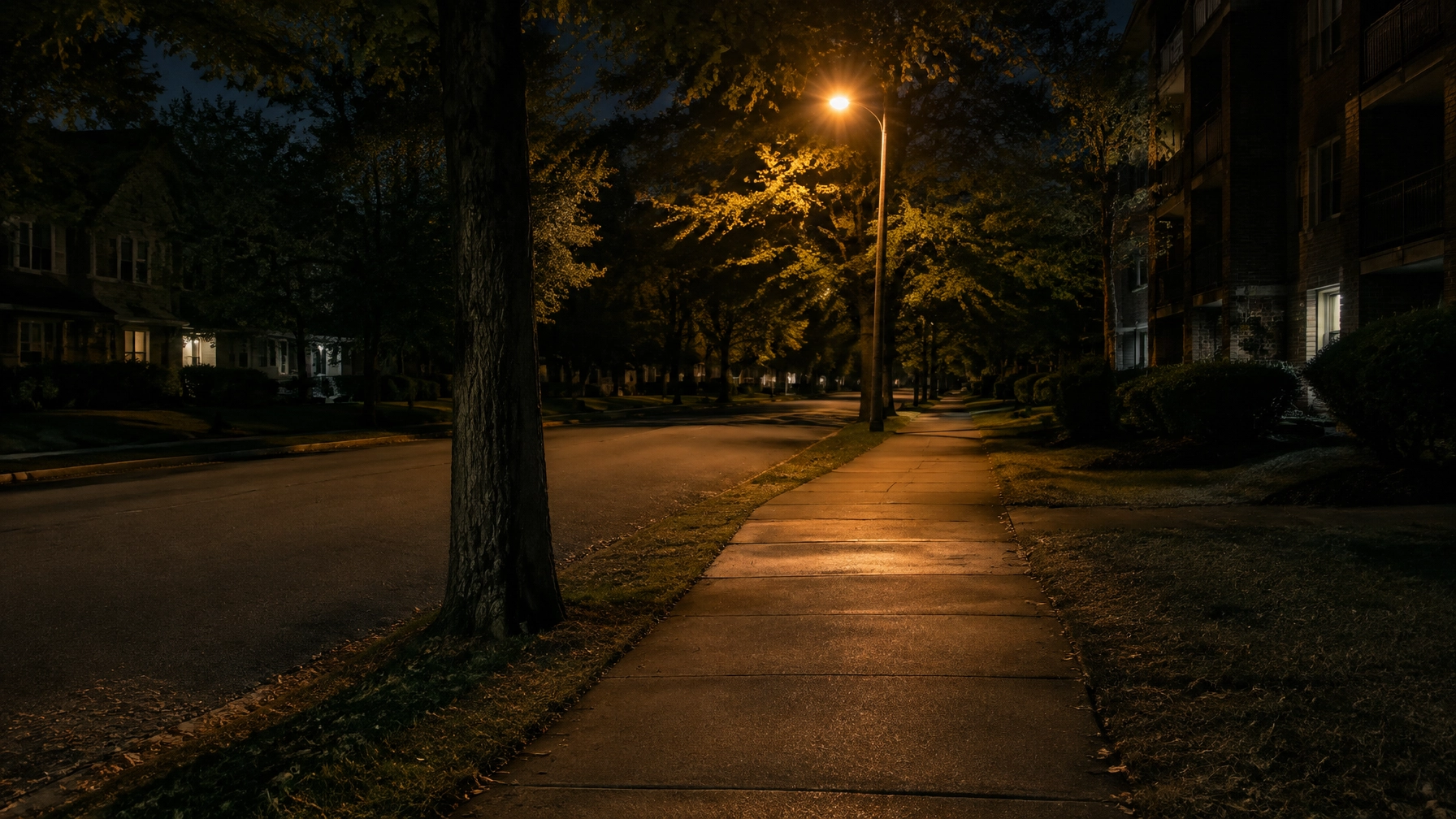

Illustration generated for The Metro Record.
**CHARLOTTE: ** Charlotte’s new youth curfew will begin Nov. 1, placing anyone under 18 under a 10 p.m. to 6 a.m. restriction every day through Aug. 31, 2027.
The City Council approved the pilot 9-2 on Sept. 28. The stated purpose is to prevent youth victimization and reduce disruptive gatherings that police and city officials have described as “teen takeovers.” The central question is narrower and more consequential: will the pilot protect young people without placing Black and brown youth under greater police scrutiny?
The city has announced quarterly reviews and demographic tracking by CMPD to monitor for unintended racial disparities. But the pilot has not started. The data does not yet exist, and the city has not said when it will publish the results, what form they will take or how the public will evaluate the program before the pilot ends.
That is the inquiry The Metro Record Charlotte will follow: what was promised, what happens on the street and who bears the consequences.
What the city approved
The curfew applies to anyone under 18 from 10 p.m. to 6 a.m. The stated exemptions include traveling to or from work, school or religious activities, responding to an emergency, or being accompanied by a parent or guardian.
The pilot runs daily for 10 months. The city says it will conduct quarterly reviews to assess its impact. CMPD is also expected to track enforcement outcomes by demographics.
The council’s vote followed concerns about gatherings organized through social media and associated by police with safety risks and crime. Local commentary has questioned whether every gathering described as a teen takeover actually involved teenagers, arguing that some included adults. That remains reported commentary, not a finding by Metro Record.
City officials have framed the curfew as a prevention measure rather than a punishment. Police Chief Estella Patterson has said the objective is to protect young people and reduce the conditions in which they may become victims or participants in crime.
The policy’s reach, however, extends beyond the groups that prompted the debate. It applies citywide to every minor who is in public after 10 p.m. without an exemption.

Illustration generated for The Metro Record.
What enforcement will look like
Patterson has said officers will not conduct traffic stops based solely on suspicion that someone is out past curfew. She has described an approach centered on education, warnings and parental notification, with arrest or a curfew violation as a last resort.
Those commitments are important. They are also commitments about policy, not enforceable limits that answer every question about street-level discretion.
Officers will still decide whom to approach, when to ask questions, how to assess an exemption and whether to contact a parent or take a more formal action. Those decisions will determine the pilot’s practical effect more than the language of the ordinance alone.
The difference between a warning, a citation and custodial action will matter. So will the location of encounters, the age of the young people involved, the reason they were out and whether officers treated comparable situations consistently.
The city has not yet explained what accountability exists if enforcement diverges from the approach Patterson announced. Metro Record is asking that question. We do not yet have an answer.
A young person stopped while walking home from a late shift and a young person stopped while leaving a party may both be covered by the same rule. The encounters may look very different depending on the neighborhood, the setting and the assumptions made about why each person is outside.
That is the asymmetry at the center of the pilot. The curfew applies to every minor in Charlotte. The consequences of being stopped do not necessarily feel equal to every minor.
The data cuts in two directions
Local coverage has reported that Black and Hispanic youth make up the vast majority of juvenile violent crime victims in Charlotte.
Supporters of the curfew cite that pattern as evidence that young people need greater protection during late-night hours. If Black and Hispanic youth are disproportionately represented among victims, the argument goes, a policy aimed at reducing dangerous nighttime gatherings could help protect the young people most exposed to harm.
Critics read the same data differently. Community organizers, some council members and the ACLU of North Carolina argue that the youth most at risk of victimization may also be the youth most likely to be stopped, questioned or cited under a citywide curfew. They contend that police contact will not address what they describe as the underlying problem: the lack of safe, accessible third spaces where young people can gather.
Both readings identify a real issue. The same population the city says it wants to protect may be the population most affected by enforcement.
The city’s demographic tracking is supposed to show whether that concern is borne out. But no pilot data has been collected. The public does not yet know whether the city will release encounter-level information, aggregate totals or a different format. It is also unclear whether the figures will distinguish warnings from citations, custodial action and other police contacts.
Without those distinctions, a simple count of enforcement actions could conceal how the policy is operating. A low number of citations could coexist with a high number of informal stops. A reduction in reported gatherings could reflect a change in behavior, a change in police reporting or a shift in where young people spend time.
The quarterly reviews will be consequential only if residents can see what is being reviewed.
A young person asked for safeguards
A 16-year-old Charlotte student presented a youth protection plan to the City Council before the pilot was approved. Her proposals included a safety pathway for returning young people to their families, clear information about their rights, public encounter data, youth input, outside review of complaints and anti-retaliation protections.
The proposals are documented in public reporting and the council record. Some elements were incorporated into the pilot. Others were not.
The Metro Record Charlotte is not naming the student because she is a minor. She spoke publicly before the council, and her proposals are part of the public record.
That sequence raises a question the city has not resolved: will officials reconsider the safeguards that were excluded after the pilot begins?
The student’s plan did not reject the need for safety. It sought to define how safety would be measured and how young people could challenge an encounter they believed was mishandled. Those are operational questions, not abstract objections.
The city will have to decide whether youth participation ends with testimony before the vote or continues through implementation and review.

Illustration generated for The Metro Record.
What we do not know
Several facts will not be available until the pilot is underway:
- What demographic patterns will appear in enforcement data.
- When CMPD and the city will publish that data.
- Whether the figures will separate warnings, citations and custodial action.
- Whether quarterly reviews will be public.
- Whether funding has been attached to the third-space alternatives critics say are missing. No figure is currently available.
- What will happen after Aug. 31, 2027: whether the pilot will lapse, be extended or become permanent.
- Whether the city will adopt any of the safeguards the student proposed that were excluded from the approved pilot.
Those questions are central to the policy’s political future. If officials want the curfew continued, they will need evidence that it reduced harm without imposing unequal enforcement. If critics want it withdrawn, they will need a public record showing what the pilot did and failed to do.
The city has created the mechanism for that evaluation. It has not yet established how residents will see the results or how officials will respond if the results show a problem.
Timeline
- Sept. 28, 2026: Charlotte City Council approves the youth curfew pilot, 9-2.
- Nov. 1, 2026: The pilot begins. The curfew runs daily from 10 p.m. to 6 a.m.
- Quarterly reviews: The city says reviews will occur, but dates have not been published.
- Aug. 31, 2027: The pilot ends unless the city takes further action.
The Metro Record Charlotte is a new publication. This is the kind of policy-on-your-block reporting the publication intends to keep doing: following Charlotte local politics beyond the vote, examining how decisions reach neighborhoods and waiting for the public record to show who benefits and who bears the cost.
The city has stated its goal. CMPD has stated its enforcement approach. The demographic data, the review schedule and the pilot’s final outcome are still awaited. That is where the accountability work begins.
Sources
- WFAE, “CMPD chief: How Charlotte’s new youth curfew will work,” Oct. 1, 2026
- WFAE, “Charlotte council passes teen curfew pilot program,” Sept. 29, 2026
- The Charlotte Observer, “Charlotte sets 10 p.m. curfew for all minors under 18 to help curb ‘teen takeovers,’” Sept. 29, 2026
- ACLU of North Carolina, “Youth Curfews Are Not What Our Cities Need”
- WBTV, “Charlotte 16-year-old advocating for youth protection amid new curfew,” Oct. 2, 2026
- WBTV, “Will Charlotte’s teen curfew work? Neighbors have mixed reaction to pilot program,” Sept. 29, 2026