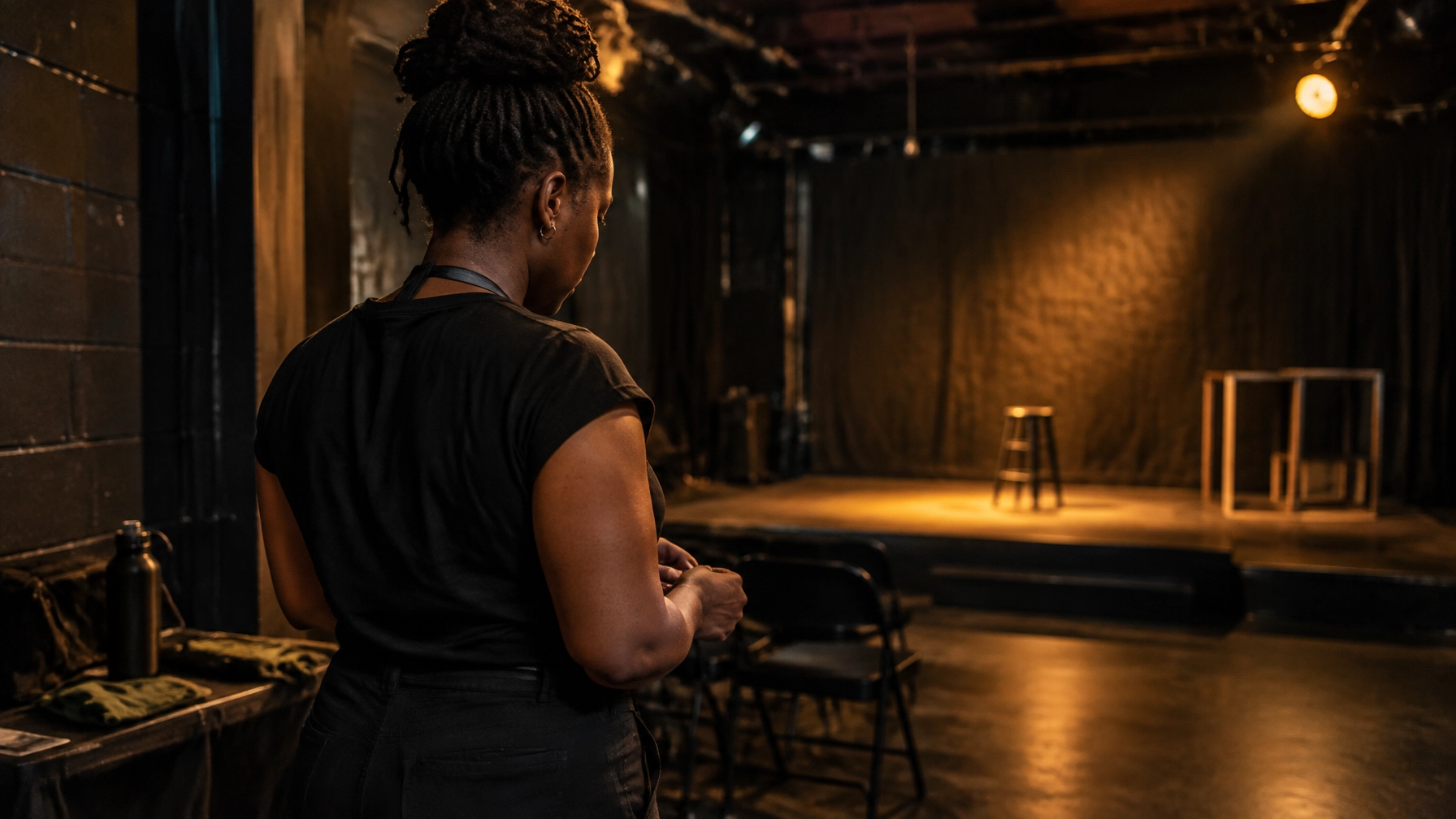
Illustrative image. The image does not depict a BOOM artist or a specific Fall Fringe production.
**CHARLOTTE: ** The word “fringe” can suggest work operating outside the center of cultural life. In Charlotte, it also describes a working method: make the room smaller, lower the cost of entry, shorten the distance between artist and audience, and give experimental work a place to exist before a larger institution decides whether it is ready.
BOOM Charlotte’s Fall Fringe weekend will bring that method to the VAPA Center on Oct. 3–4. The two-day event is a fall extension of BOOM’s annual spring festival, with five ticketed performances, a party, free programming, artist conversations and pop-up performances across two stages.
The weekend gives Charlotte audiences a concentrated way to encounter work that may not fit neatly into a conventional theater, gallery or concert calendar. It also offers a useful window into the role fringe arts play in the city’s broader cultural system, and into the artists who are more likely to find room there than in traditional spaces.
Fringe is a format, not a genre
BOOM describes itself as Charlotte’s artist-led showcase of contemporary and experimental performance and visual art created “on the fringes of popular culture.” Its Fringe program is part of a global movement known for presenting local and national artists in intimate venues, often with work that is new, unfinished, hybrid or difficult to classify.
Fringe does not necessarily mean obscure. It can include dance, theater, comedy, poetry, music, visual art or several of those forms at once. What links the work is often the setting and the relationship with the audience.
At its best, the fringe model runs on trust rather than pedigree. An audience can take a chance on a $12.50 ticket without treating the purchase as a major commitment. An artist can work in a room that does not require the scale, polish or institutional history expected of a mainstage production. The exchange is direct: a small number of people enter a room, and the work has an opportunity to meet them there.
Shorter performances are part of that structure. A compact work can be built with fewer technical demands, presented in a smaller venue and scheduled alongside other performances. For audiences, shorter formats make it possible to see more than one work in a day without committing to a single long production. For artists, they can create a workable path from idea to public presentation.
That does not make the work less serious. It changes the conditions under which seriousness is judged.
BOOM’s history is rooted in access
BOOM was founded in 2016, according to reporting by WFAE and Queen City Nerve, after the 2012 Democratic National Convention helped prompt the development of Que-OS, the nonprofit behind the festival. The concept drew from the international Fringe movement while responding to Charlotte’s independent arts scene.
BOOM is a production of Que-OS, a 501(c)(3) nonprofit. Its stated mission is to “create open, inclusive platforms and cultivate intentional opportunities for creative professionals to collaborate.” The organization says it invites “those left out of traditional art spaces to experience the transformative power of art” and envisions a city where everyone has access and opportunity to create, grow and thrive.
That language describes more than a programming preference. It identifies a problem in the arts economy: artists often need a history of institutional presentation to receive institutional presentation. Artists whose work is community-based, politically engaged, culturally specific or formally unconventional can be asked to prove themselves inside systems that were not built around their practices.
BOOM’s broader roster shows how the fringe has functioned in Charlotte. Black Poetry Theatre creates original theater centered on poetry, spoken word and hip-hop culture. Its 2026 BOOM production, The Adventures of Mystery Green, was a staged reading by playwright Dasan Ahanu. Charlotte Cultural Collective has presented fusion dance highlighting the Black Diaspora. The Protect the Web Showcase, organized by Hector Vaca Cruz of Action NC, brought Charlotte-area creatives together around artistic activism responding to attacks on immigrant and refugee communities.
Those examples are from BOOM’s spring festival roster, not the Fall Fringe lineup. Together, they show how Charlotte’s fringe programming has repeatedly made room for Black, diasporic and immigrant-community artists. That work is not a diversity add-on to the bill. It is part of what the bill is.

Illustrative image. The image does not depict the Fall Fringe venue or a specific BOOM production.
The spring festival provides the scale
BOOM’s ninth annual spring festival ran May 1–3, 2026, at The Boardwalk at University City. The festival featured approximately 400 artists and more than 100 performances spanning dance, music, theater, poetry and visual art, according to WFAE and BOOM’s festival materials.
Reported attendance for the 2025 festival was roughly 26,000 people. No attendance figure has been reported for the 2026 festival.
The festival’s structure combines free outdoor programming with ticketed indoor performances. That division is important. It allows people to encounter the event without paying for a ticket while preserving a paid format for work that requires a more controlled room and direct support for artists.
BOOM’s other programs follow a similar access-based logic. BOOM Intersection offers free, family-friendly outdoor performances, activities and public art. BOOM Market supports local makers, artists and food vendors. BOOM Echoes brings programming to different communities throughout the year and identifies transportation, expensive tickets and perceived elitism or exclusivity as barriers it seeks to remove.
The organization’s 2026 season lists support from Foundation For The Carolinas’ City Infusion initiative, the North Carolina Arts Council, Culture Blocks through the Arts & Science Council, South Arts and other partners. That funding structure places fringe work inside a wider network of public, nonprofit and philanthropic support.
Why VAPA is the right building
The VAPA Center is not simply a venue rented for a weekend. It is part of the infrastructure that allows independent arts work to happen.
The VAPA Center is a nonprofit arts collective in Charlotte that provides below-market studio, rehearsal and performance space for local artists and organizations, with galleries, theaters and artist studios, and it is open to the public.
VAPA’s model addresses one of the least visible costs of cultural production: space. A city can have artists, audiences and ideas, but those elements do not become a scene without rooms that artists can afford to use.
The center hosts regular open studios and a night market and is open to the public. Its location and mixed-use character make it a fitting home for fringe work. Audiences can move through a building where art is being made, stored, rehearsed and performed rather than entering a single-purpose hall for a single scheduled event.
Charlotte’s larger arts institutions have expanded the city’s downtown cultural footprint, creating more opportunities for major productions and large audiences. The city’s cultural health, however, is measured at least as much by what happens in a converted studio building on North Tryon as by what happens in a renovated hall. The two systems can grow together. One provides scale; the other provides room to test what scale may eventually include.

Illustrative image. The image is not a documentary photograph of the VAPA Center.
What will be on the Fall Fringe schedule
Organizers describe the fall weekend as a chance to revisit works from earlier seasons alongside new live performance, artist conversations and pop-up performances.
The confirmed ticketed schedule includes:
- Saturday, Oct. 3, 6:30 p.m.: Fall Fringe Pass access begins in the VAPA Center’s Encore Room.
- Saturday, Oct. 3, 7:30 p.m.: Follow the Glow by Svetlitsa, in the Encore Room.
- Saturday, Oct. 3, 7:30 p.m.: Fall Fringe Party: Sweat Transfer, a curated Spark Party, in the Encore Room.
- Sunday, Oct. 4, 1 p.m.: Born Under an Azalea Bush: An Ode to Southern Gothicism by Sade Sade, at Charlotte Comedy Theater.
- Sunday, Oct. 4, 2:15 p.m.: Two Selves by Kaustavi Sarkar, in the Encore Room.
- Sunday, Oct. 4, 3:30 p.m.: A Secret Third Thing, described by organizers as a one-human show combining poetry, comedy and storytelling to break down binaries of all types, at Charlotte Comedy Theater.
- Sunday, Oct. 4, 5:30 p.m.: Fall Fringe Showcase, featuring Memories of Peru by Angela Castillo and Mauricio Salas and Build A Man by Frank Expression, in the Encore Room.
Single-show tickets cost $12.50 to $15. The Fall Fringe Pass costs $35 to $40 and includes all five ticketed shows plus the Oct. 3 after-party.
The pass exists for the same reason fringe festivals often schedule multiple short works in one place: it gives audiences a way to follow the weekend rather than making each performance an isolated decision. First-time attendees do not need to buy one. BOOM’s ticket page says audiences can come for one show, stay for several, or drop in for a free performance or conversation. The free programming and conversations are referenced by organizers but are not listed in a complete public schedule.
A first visit does not require specialized knowledge. Expect work that may not explain itself immediately, a room that may be closer to the performer than expected and an audience response that varies from show to show. Read the published description, choose a manageable ticket and allow the work to establish its own terms. The point is not to arrive already certain that the experiment will succeed.
It is to make space for the experiment to be seen.
Event information
- Event: BOOM Fall Fringe at VAPA
- Dates: Oct. 3–4, 2026
- Venues: VAPA Center and Charlotte Comedy Theater, both within the VAPA complex
- Building address: 700 N. Tryon Street, Charlotte, NC 28202
- Parking entrance: 736 N. College Street. Some ticketing and event listings use this address, but it is the entrance to VAPA’s free parking lot, not the building’s street address.
- Tickets: Single shows, $12.50–$15; Fall Fringe Pass, $35–$40
- Details: Visit the official BOOM ticket page and confirm schedule, access and venue details with the organizer before attending.
For readers following Charlotte arts coverage, BOOM’s fall weekend offers a practical definition of fringe culture in the city. It is not separate from Charlotte’s cultural system. It is one of the places where that system remains flexible enough to hear new voices, support unfamiliar forms and make room for artists who have not been waiting for permission.
Sources
BOOM Fall Fringe ticket page · BOOM Charlotte about page · WFAE report on the 2026 festival · Queen City Nerve report on BOOM’s move to University City · Black Poetry Theatre artist page · VAPA Center about page