
By JR Byrd
Review | September 21, 2026
**CHARLOTTE: ** Choir music is here to stay.
That was the clearest conclusion from the Mitchell Johnson & Rehoboth 10th Anniversary Concert on Saturday, September 19, at The Connecting Place at Greater Salem. The concert was a celebration of a decade of work, but it also functioned as a rebuttal to the idea that choir music belongs only to an earlier generation or survives mainly through nostalgia.
The sanctuary was full. The music was active, carefully arranged and rooted in the Black church tradition without being trapped by it. Mitchell Johnson & Rehoboth presented itself not as a commemorative ensemble looking backward, but as a working musical institution with a continuing role in Charlotte’s cultural life.

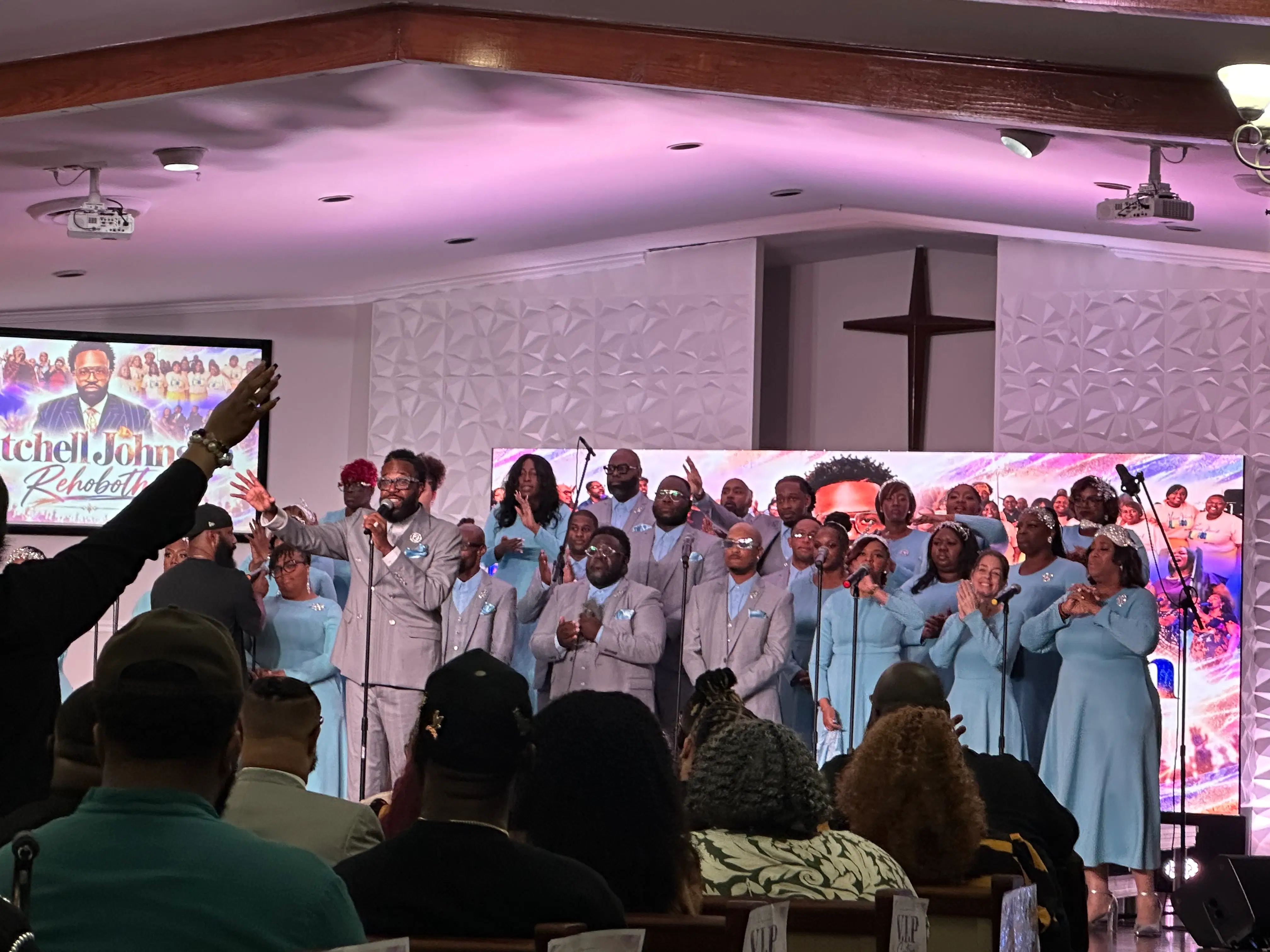
The sanctuary at The Connecting Place at Greater Salem was staged as both a church and a concert hall, with the anniversary message projected above the platform. Photograph by JR Byrd.
A church sanctuary became a concert hall
The visual design established the evening’s balance between worship and performance. White textured acoustic panels framed a wooden cross above the platform. Chandeliers hung over the sanctuary, while purple and pink light washed across the projection screens. Wooden pews carried “VIP Seating” placards, and the screens invited attendees to record short clips and share them using #MJRehoboth10.
The staging was polished without separating the concert from its church setting. Microphones, instruments and a live band occupied the platform, but the central image remained the choir: Mitchell Johnson & Rehoboth in coordinated light blue dresses and light gray suits, and Corey Prather and High Praize in pink and red. The presentation made the scale of the anniversary visible. This was not a solo showcase with background vocals. It was a collective musical body.
That distinction is important. A community choir requires more than a lead singer with a strong voice. It requires rehearsal, vocal discipline, musical direction and an understanding of how individual parts become one sound. Johnson has spent the past decade building that structure.
Johnson is a Charlotte-based gospel recording artist, musical director and educator who founded Mitchell Johnson & Rehoboth in 2016. His catalog includes “God Is Great,” “He Can Do Anything” and “Better for Me.” He has also served as a lead vocalist for Melvin Crispell and Testimony, and Mitchell Johnson & Rehoboth has performed at Hezekiah Walker Choirfest. The ensemble held an album release event in September 2025.
Those accomplishments provide context, but the anniversary concert made the case through performance. The choir’s strength came from its layered harmonies and its ability to move between restraint and release. The arrangements left room for individual voices while returning repeatedly to the larger sound of the ensemble. The music did not depend on volume alone. Its impact came from control, timing and the accumulated force of many singers moving together.
Tradition was treated as material, not a limitation
Corey Prather and High Praize, a Chattanooga-based gospel choir, appeared as featured guests. As heard that night, they performed a mixture of older gospel material with new treatments. The approach respected the source material while giving it a different rhythmic and vocal shape.
That kind of interpretation is central to the continued life of gospel choir music. Tradition is not preserved by repeating it without change. It remains useful when musicians understand its structure well enough to reshape it. High Praize brought that perspective from outside Charlotte, adding a regional dimension to the anniversary.
Their appearance also says something about the gospel circuit connecting Black churches and artists across the Southeast. A Charlotte choir’s 10th anniversary included a Chattanooga ensemble known for its traditional sound and its 2025 live project, 40/20 Live in Chattanooga. The exchange was more than a guest appearance. It reflected a network of artists, churches, directors and audiences that continues to develop beyond the attention of mainstream entertainment coverage.

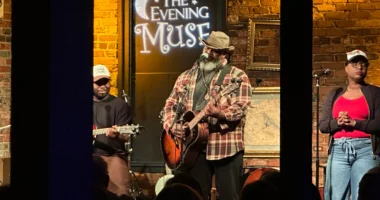
Corey Prather and High Praize perform during the anniversary program, with their name projected on the sanctuary screens. Photograph by JR Byrd.
D. Morton & Gifted also appeared during the evening, identified in the program graphics displayed on the sanctuary screens. Their presence added another ensemble to a program built around the continuing strength of group vocal performance.

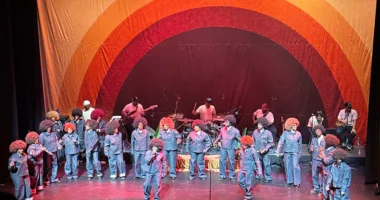
D. Morton & Gifted appear on the platform during the anniversary program. Photograph by JR Byrd.
The program’s video congratulations extended that sense of connection. Messages were shown from Cedric and LeJuene Thompson, Christopher Erving and Patrick Love.
Cedric Thompson is a Grammy-nominated gospel producer, while LeJuene Thompson is a gospel recording artist whose work includes the album Soul Inspiration. Patrick Love, a Charlotte gospel musician, singer, songwriter, producer and arranger, is known for his work with the A.L. Jinwright Mass Choir. His albums Wait on the Lord and The Vision charted on Billboard’s Gospel Albums chart.
The messages recognized Johnson and Rehoboth as part of a larger history. They also placed the ensemble within a living community of Black gospel musicians whose influence reaches from local sanctuaries to nationally recognized recordings.
The next decade was part of the program
Elder Monique Attaway performed “What’s to Come” and spoke of miracles, signs and wonders to come. The selection carried a fitting message for a 10th anniversary. The evening acknowledged the work already completed, but it did not present the past decade as a conclusion.
“What’s to Come” shifted the focus forward. The song and the message suggested that the anniversary was not simply an occasion to remember what Mitchell Johnson & Rehoboth had built. It was also a statement of expectation about what the ensemble could continue to produce, teach and influence.
That forward movement is especially significant in Charlotte, where Black cultural institutions often develop substantial audiences before receiving sustained coverage or institutional support. Choirs train singers, create opportunities for musicians, preserve musical knowledge and give communities a place to gather around shared expression. They are often treated as background to the city’s cultural story, even when they are doing the work of building that story.
The anniversary concert offered a correction. The ensemble has lasted ten years. It has released music, performed beyond Charlotte, welcomed regional guests and maintained a full-room audience at home. The work does not require outside validation to exist, but it deserves serious attention from the cultural institutions and media organizations that decide what counts as the city’s official arts landscape.
That question belongs within any serious account of charlotte nc culture. It also belongs in charlotte community news, because community choirs are not only entertainment organizations. They are spaces where people build relationships, develop skills and sustain traditions that have carried Black communities through generations of social and economic change.
Charlotte local news has often measured cultural importance through large venues, corporate sponsorships and nationally recognized names. The Mitchell Johnson & Rehoboth anniversary offered another measure: consistency. A director who continues to teach. Singers who return to rehearse. A choir that makes records and fills a sanctuary. A regional ensemble that travels to participate. An audience that shows up.
A decade that sounds unfinished
The concert’s strongest quality was its sense of continuation. The music honored the older language of gospel while allowing contemporary arranging, visual presentation and regional collaboration to shape the night. The result was neither a museum display nor a recreation of an earlier era.
It was current.
Mitchell Johnson & Rehoboth demonstrated why choir music remains durable in Charlotte. The form offers room for discipline and improvisation, individual expression and collective power. It can carry memory without becoming fixed in the past. It can operate within a church and still function as a serious concert experience.
The anniversary was therefore more than a milestone. It was evidence of infrastructure: ten years of direction, education, rehearsal, recording and performance. It showed what can happen when Black artists and community institutions continue investing in their own musical traditions, even when the broader cultural economy gives them less attention than they have earned.
The message of the evening was present in the music and in the room itself. The choir is not fading into history. It is adapting, gathering new audiences and connecting Charlotte to a wider gospel network.
Choir music is here to stay.